Classroom Breakdown
Get Started
1. Infant Classroom (6 weeks –12 months)
Developmental Focus:
-
Physical: Encouraging motor skills like reaching, rolling over, sitting, and crawling through sensory activities, tummy time, and safe exploration.
-
Social: Building basic social-emotional skills through attachment, bonding with caregivers, and group interactions with peers.
-
Cognitive: Engaging the infant’s senses through music, language, and tactile exploration of toys to enhance cognitive awareness.
-
Language: Focus on receptive and expressive language, including hearing a variety of sounds, listening to songs, and encouraging babbling.
Curriculum Highlights:
-
Sensory exploration (textures, colors, sounds)
-
Gentle introduction to routines and transitions
-
Safe exploration and movement opportunities
-
Social-emotional bonding with caregivers
-
Parent engagement through daily updates and milestone tracking

2. One-Year-Old Classroom (12–24 months)
Developmental Focus:
- Physical: Supporting walking, standing, and climbing, improving fine motor skills with stacking, scribbling, and simple hand-eye coordination activities.
- Social: Encouraging parallel play and basic social interactions like sharing and taking turns.
- Cognitive: Simple problem-solving activities like fitting shapes into holes, identifying colors, and basic cause and effect.
- Language: Building vocabulary through daily conversation, simple songs, and reading age-appropriate books.
Curriculum Highlights:
- Introduction to structured play with toys and manipulatives
- Exploration of textures and materials for sensory development
- Basic sign language for communication and social bonding
- Short group activities to introduce sharing and cooperation
- Music, rhythm, and movement to promote language skills and gross motor development
3. Two-Year-Old Classroom (24–36 months)
Developmental Focus:
-
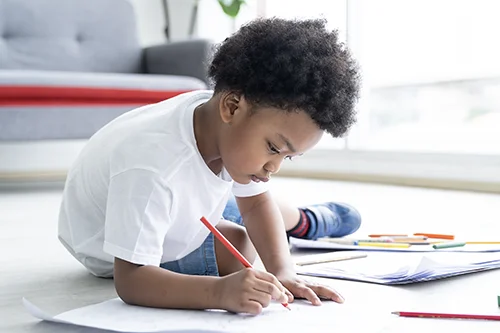
Physical: Enhancing motor skills with more complex activities like climbing, jumping, and drawing with crayons. Beginning to develop hand-eye coordination and spatial awareness.
-
Social: Encouraging cooperative play, developing friendships, and practicing emotional regulation through guided activities and group interactions.
-
Cognitive: Introducing basic math concepts (counting, matching) and early literacy (letters, sounds). Encouraging imaginative play and problem-solving.
-
Language: Expanding vocabulary, forming simple sentences, and using language to express needs and thoughts. Starting to engage in short conversations.
Curriculum Highlights:
-
Sensory and creative play (water, sand, playdough)
-
Simple problem-solving tasks, puzzles, and shape sorting
-
Storytime with active participation (songs, clapping, repeating)
-
Group activities that promote teamwork and sharing
-
Exploration of basic math concepts and early literacy

4. Three & Four-Year-Old Classroom (Preschool/Pre-K, Trailer)
Developmental Focus:
- Physical: Developing fine motor skills with cutting, drawing, and building. Enhancing gross motor skills through active play such as running, jumping, and dancing.
- Social: Strengthening peer relationships and communication, teaching conflict resolution, and practicing self-regulation.
- Cognitive: Building foundational math and literacy skills, including counting, simple addition and subtraction, letter recognition, and beginning phonics. Developing problem-solving skills and critical thinking.
- Language: Expanding vocabulary, constructing full sentences, and understanding sentence structure. Preparing for more complex conversations and storytelling.
Curriculum Highlights:
- Early literacy through storybooks, letter games, and songs
- Basic math concepts: numbers, shapes, patterns, and measurement
- Hands-on science experiments and exploration
- Art and creative activities (painting, drawing, crafting)
- Group learning and discussions to improve social and language skills
- Kindergarten readiness activities: following instructions, listening skills, and personal responsibility
Technology Integration at Curious Rose
At Curious Rose, we integrate technology in a developmentally appropriate way. Our goal is to introduce young children and their families to creative skills that complement and enrich the learning activities in the classroom. Instead of relying on technology as the main educational tool, we incorporate it in ways that enhance creativity, collaboration, and learning.
Key Points about Technology Integration:
- Technology is used as a supplementary resource to enrich structured activities and materials.
- Learning apps and tools are selected carefully to align with developmental goals, such as enhancing fine motor skills or promoting creativity.
- Digital storytelling, music, and videos are used to introduce new concepts and engage children in interactive ways.
- Teachers use technology to document children’s progress and share it with families through personalized updates and reports.
Collaborative Play and Learning:
- Curious Rose encourages collaborative learning through interactive play, which is essential for cognitive and social development. We foster a community environment where children work together on projects, share ideas, and express themselves creatively.
Curious Rose is a place where young children can access technology in a way that supports their growth and learning. Our philosophy embraces a balanced approach—introducing technology thoughtfully, supporting hands-on learning, and ensuring that each child’s academic, social, and emotional needs are met. By the time our students are ready for kindergarten, they will have a solid foundation in skills that will set them up for success in school and beyond.
Get in Touch
"*" indicates required fields